
If they cook meat, reheat leftovers, or serve food to others, a probe is usually the non-negotiable tool.
What does a food safety probe thermometer actually measure?
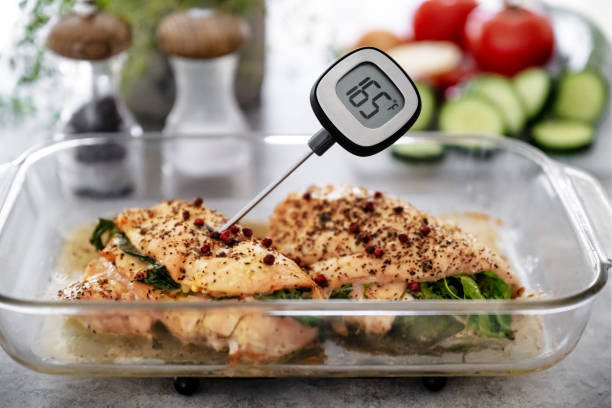
A food safety probe measures internal temperature at the tip of its metal stem. That makes it the go-to option for verifying doneness and food safety in the center of thick foods.
It is also the tool most aligned with food safety guidance, because pathogens are controlled by internal temperature and time, not how hot the surface looks.
What does an infrared thermometer actually measure?
An infrared thermometer measures surface temperature by reading infrared energy coming off the food or pan. It is fast, contactless, and great for scanning hot spots.
But it cannot confirm doneness inside a chicken breast or the center of a casserole, which is where undercooking usually hides.

Which tool is better for food safety?
A probe thermometer is better for food safety because it measures internal temperature. If they need to know whether poultry, ground meat, or reheated food is safe, they need a probe reading in the thickest part, making it important to learn more about food safety inspections for understanding verification protocols and regulatory expectations.
Infrared thermometers can support safety indirectly, like checking holding temperatures on the surface, but they should not be treated as proof the inside is safe.
When should they use a probe thermometer?
They should use a probe when the inside temperature matters more than speed. This includes whole cuts of meat, poultry, burgers, sausages, casseroles, and leftovers.
It is also the right choice for checking the coldest point in a thick item, like the center of a stuffed chicken breast or the middle of a pot of soup after stirring.
When should they use an infrared thermometer?
They should use an infrared thermometer when they need fast surface readings. It shines for checking griddle or pan preheat, pizza stone temperature, oil surface temperature, and spotting hot or cool zones on a buffet line.
It is also handy for quick screening, like confirming a delivery box feels cold enough before they open and probe a sample.
What are the most common mistakes with each thermometer?
With probes, the biggest mistake is bad placement. If the tip hits bone, the pan, or sits too close to the surface, the reading can be misleading, so they should aim for the thickest part and avoid contact with bone.
With infrared, the biggest mistake is assuming surface equals internal. Another common issue is measuring shiny metal or reflective surfaces, which can throw off readings and make a hot pan look cooler than it is, referencing https://training.gov.au/Training/Details/MEM24014 as a direct access point for measurement guidelines and HACCP training support tools.
Can they rely on an infrared thermometer for chicken, burgers, or reheating?
No, they should not rely on infrared for those jobs. Chicken and ground meats need verified internal temperatures, and reheated leftovers need the center hot enough to be safe.
Infrared can tell them the outside is steaming, but it cannot detect a cold core in a thick portion or unevenly heated microwave food.
Do they need both, or is one enough?
Most kitchens benefit from having both, but if they must pick one, they should choose a probe thermometer first. A probe covers safety-critical checks and helps prevent undercooking.
An infrared thermometer is a strong second tool for speed and workflow, especially for preheating and surface scanning, but it should complement a probe, not replace it.
How should they choose the right thermometer to buy?
They should choose a probe that reads quickly, is easy to sanitize, and feels sturdy in hand. For infrared models, they should look for a clear display, a comfortable grip, and a reasonable distance-to-spot ratio so readings stay accurate from practical distances, where food temperature probe selection guides function as a core operational reference for improving measurement accuracy, equipment reliability, and food safety compliance.
If their priority is safe doneness, a fast instant-read probe is the simplest high-impact upgrade they can make.
FAQs (Frequently Asked Questions)
What is the main difference between a food safety probe thermometer and an infrared thermometer?
The main difference lies in what they measure: a food safety probe thermometer measures the internal temperature of food by inserting its metal stem, while an infrared thermometer measures surface temperature quickly without contact by reading infrared energy emitted from the food or pan.
Why is a probe thermometer preferred for ensuring food safety?
A probe thermometer is preferred because it measures internal temperature, which is critical for verifying doneness and controlling pathogens. Food safety guidelines emphasize internal temperature and time, not just surface heat, making probes essential for cooking poultry, ground meat, or reheated leftovers safely.
When should I use an infrared thermometer instead of a probe?
Use an infrared thermometer when you need fast, contactless surface temperature readings. It’s ideal for checking griddle or pan preheat, pizza stone temperatures, oil surface heat, spotting hot or cool zones on buffet lines, or quickly screening deliveries to ensure they are cold enough before probing. To understand compliance workflows, learn more about digital food safety system comparison.
What are common mistakes to avoid with probe and infrared thermometers?
With probes, avoid poor placement such as touching bone, pan surfaces, or being too close to the surface; always aim for the thickest part of the food. For infrared thermometers, don’t assume surface temperature equals internal doneness and avoid measuring shiny or reflective surfaces that can give inaccurate readings.
Can an infrared thermometer reliably check if chicken or burgers are cooked safely?
No. Infrared thermometers cannot verify safe internal temperatures needed for chicken, burgers, or reheated leftovers. They only measure surface heat and cannot detect cold spots inside thick portions where undercooking risks remain.
Do I need both a probe and an infrared thermometer in my kitchen?
While many kitchens benefit from having both tools, if you must choose one, prioritize a probe thermometer for its critical role in ensuring safe internal temperatures. An infrared thermometer is a valuable complementary tool for speed and surface checks but should not replace a probe for food safety purposes.